Technology
The international master’s program in Energy Management prepares you for a managerial career in the energy sector. The program is a continuing education master’s degree that teaches you the technical, legal, economic, business management, and entrepreneurial aspects of energy management and equips you with the skills required to work in the energy sector. You will acquire knowledge of the technical principles of energy generation, distribution, and use and the economic, ecological, and societal conditions in which these occur. The program provides you with a thorough understanding of the general legal conditions of competition and regulatory law as well as the planning, implementation, and controlling of integrative management. Key interdisciplinary skills, such as the use of new media and information technologies as well as intercultural dialogue and communication skills, also play a key role in the syllabus.
The MBA in Energy Management offered by the Technische Universität Berlin is the right choice for you if you wish to find strategic solutions to current world problems related to the energy sector! This MBA teaches students the economic, legal, political, and technical aspects of managing energy markets. Moreover, since Germany stands out as a leader of the global energy transition, you’ll have the great opportunity to learn the latest trends while living in one of the most vibrant metropolises of the world and studying at Technische Universität Berlin, one of Germany’s most renowned universities, part of the TU9 initiative and awarded as a “University of Excellence”.
Energy Management MBA’s mission is to empower professionals to become global leaders in the energy sector by equipping them with cutting-edge knowledge of energy systems, sustainable technologies, and innovative business strategies. Through interdisciplinary learning, practical applications, and industry collaboration, we aim to foster the development of solutions that address global energy challenges, drive the transition to sustainable energy systems, and shape a future of economic and environmental resilience.
The Energy Management MBA is designed to offer the most valuable industrial MBA programme in the energy sector for professionals seeking to gain international business expertise and managerial proficiency that will enhance their careers. Additionally, the programme aims to cultivate future business leaders who are committed to sustainable development on a global scale.
A set of strategic objectives has been defined, with the aim of establishing the EM MBA as a quality and best value-added industry MBA programme:
Energy Management (MBA) program’s aims, objectives and learning outcomes are aligned with our vision, mission and values. While EM MBA’s five-year strategic development plan provides a roadmap to achieve our mission, our explicit learning outcomes establish Students’ expectations of knowledge and understanding upon completion of the program. EM MBA has structured the program to achieve these learning outcomes.
Energy Management (MBA) aims to develop socially responsible professionals and business leaders, who are confident in English, think with a global perspective, make decisions with cross cultural understanding in mind, create sustainable business environments and possess insatiable desire for life-long learning.
At the conclusion of this degree program, students will be able to:
The program is accredited within the system accreditation of the TU Berlin. Here you can find the certificate as PDF.
Part of sustainability is quality management. Quality should not be left to chance but be the result of a continuous improvement process. The TU Berlin changed its quality focus from the quality assurance of individual study programs to the evaluation of the university as a system. The TU Berlin has designed its quality assurance procedures in such a way that the participating actors can develop themselves in a responsible manner and in dialogue with each other. System accreditation leads to the accreditation of all study programs offered by a university.
“The subject of system accreditation is the internal quality assurance system of a university in the field of study and teaching. The structures and processes relevant for teaching and studies are examined to ensure that they achieve the achievement of the qualification objectives and the high quality of the courses, whereby the requirements of the Conference of Ministers of Education (KMK) are the European Standards and Guidelines for Quality Assurance in Higher Education (ESG), and the criteria of the Accreditation Council apply.

A positive system accreditation certifies the university that its quality assurance system in the field of study and teaching is suitable for ensuring the achievement of the qualification objectives and the quality standards of their degree programs. Degree programs that are set up according to the specifications of the accredited system or have already been subject to internal quality assurance according to the specifications of the accredited system are thus accredited.” (Own translation after German Accreditation Council of 20/02/2013.)
We are looking forward to welcoming you to this exciting program.
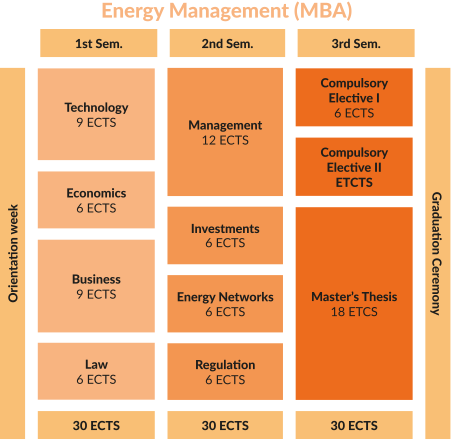
The Energy Management MBA (EM MBA) program offers a comprehensive one-and-a-half-year, full-time curriculum with a strong international focus. As the program is delivered entirely in English, proficiency in the language is a prerequisite for admission.

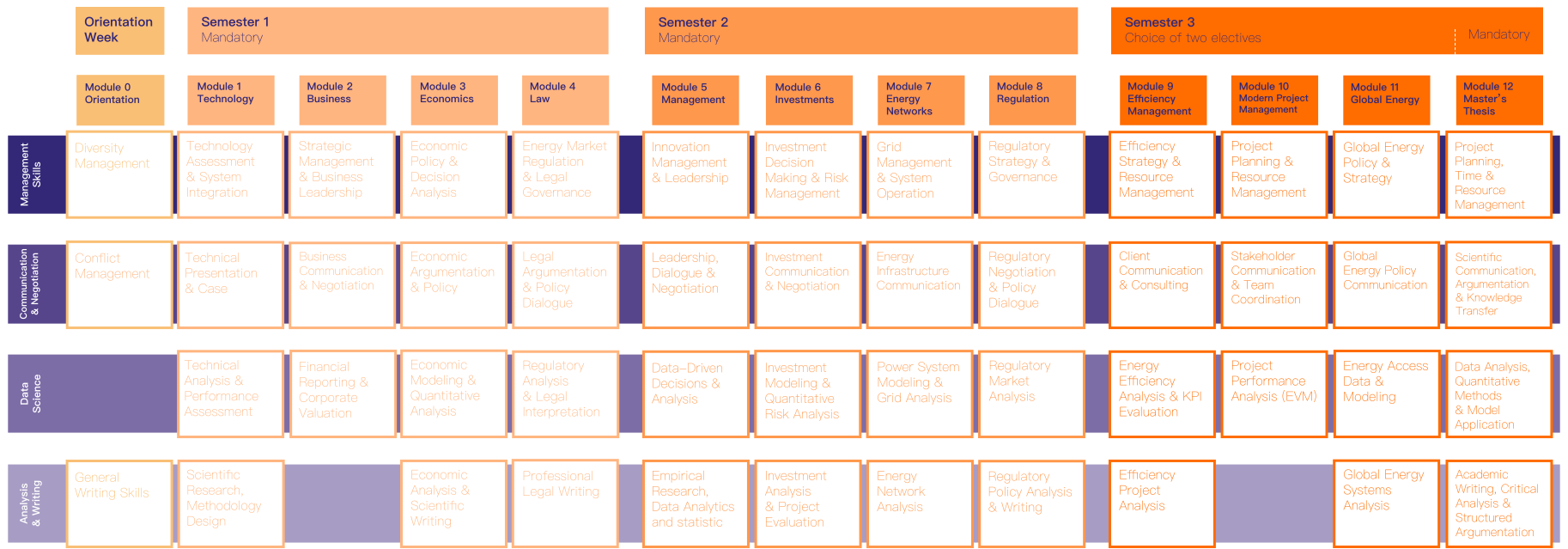
The initial semester begins with a foundational Technology Module, which introduces students to the fundamental technological aspects of the energy industry. This module is designed to equip students with an understanding of the critical technology features that underpin the sector. Following the technology module, students engage with the Business, Economy, and Law Module. This segment of the program provides an in-depth exploration of the energy market landscape, focusing on energy economic principles and the regulatory frameworks specific to the European Union's energy sector.
In the second semester, the focus shifts towards developing essential management competencies. Students receive comprehensive training in General Management principles, with a particular emphasis on applications within the energy industry. This is complemented by studies in Energy Investment and Energy Industry Regulations, which prepare students for strategic decision-making and regulatory compliance in the energy sector.
The third semester offers students the opportunity to specialize by selecting two electives from a diverse range of nine courses. This customization allows students to tailor their learning to their individual career goals and interests within the energy industry. The program culminates with the completion of a Master’s Thesis, which requires students to conduct original research on a topic relevant to the energy sector. This structured approach ensures that graduates of the EM MBA program are well-prepared to take on leadership roles in the global energy industry, equipped with a robust understanding of technological, economic, legal, and managerial aspects.


In the compulsory elective module Efficiency Management the students will be able to define, evaluate, and analyze technical projects and structures such as buildings, factories, and urban districts. They do this by integrating the technological, economic, business, and legal operations in companies and organizations and by taking social responsibility and sustainable development into account.
Two compulsory electives need to be selected. The students can also choose the elective modules offered by the Sustainable Mobility Management MBA and MBA Building Sustainability.
The overall qualification goal of the compulsory elective module Modern Project Management is to enable the students to plan, implement, and successfully complete projects economically, efficiently, and according to modern agile and classic management methods. At the end of the course, the students can act in the mediated roles in agile and classic projects, understand the essential project management processes, generate central management documents themselves, and apply and further deepen the methodology in future projects.
Two compulsory electives need to be selected. The students can also choose the elective modules offered by the Sustainable Mobility Management MBA and MBA Building Sustainability.
In the compulsory elective module Global Energy & Rural Electrification, students will learn to describe, analyze, and evaluate the role of developing and emerging countries in global energy systems as well as their local and regional challenges, peculiarities, and opportunities. Students are familiar with various off-grid technologies and can choose between them, including the use of suitable methods of integrative planning. Finally, students can act better in group projects, understand the process of development cooperation, understand and design central elements in it, and be aware of their responsibility for global and local sustainable development.
Two compulsory electives need to be selected. The students can also choose the elective modules offered by the Sustainable Mobility Management MBA and MBA Building Sustainability.
EM MBA uses a competence-based assessment of participant performance against pre-set learning objectives. It sets a threshold level to determine whether a skill or outcome has been achieved. Each module responsible lecturer decides what kind of exam form is applicable and suitable for the module that will be descripted in the module description and approved by GkmE. Generally, Exams have following forms:
In a Written Examination, students independently complete tasks with limited aids and with proctoring. Multiple choice questions and electronic examination procedures are permitted as written examination. Written examinations may also be conducted in an electronic procedure in accordance with study regulations. The duration of a written examination amounts to at least 90 minutes and no more than four hours.
Oral Examination is an exam interview, in which the task or problem is made known immediately prior to or at the beginning of the examination. Within the scope of an oral examination, written tasks may also be assigned to a reasonable extent provided that this does not alter the oral nature of the exam. Oral examinations may also be conducted in an electronic procedure in accordance with study regulations. The exam duration per candidate is at least 20 minutes and a maximum of 60 minutes. The maximum duration can be exceeded where appropriate, with the candidate's consent.
Presentation is a scientific talk on a selected topic for a module; it is held in front of other students and depending on the module description, may be combined with a discussion. A presentation lasts at least 20 and no more than 45 minutes. If a discussion is provided for, the entire duration must not exceed 90 minutes.
Portfolio Examination consists of several different types of examination elements, usually of different formats, to be completed throughout a semester and which form a uniform exam. Special consideration is given here to the written composition, multiple-choice test, presentation, recorded practical assignment, outline, creative work, consultation, or poster.
In a Term Paper, students independently address a selected topic from a module using scientific methods. The examiner determines the type and scope of the application of scientific methods. When submitting their independently prepared term paper, students must declare in writing that the paper was completed without unauthorized outside assistance and that no sources and aids other than those stated were used. Term papers include other short-form formats such as take-home exams. The term paper must be evaluated and the results announced within six weeks.
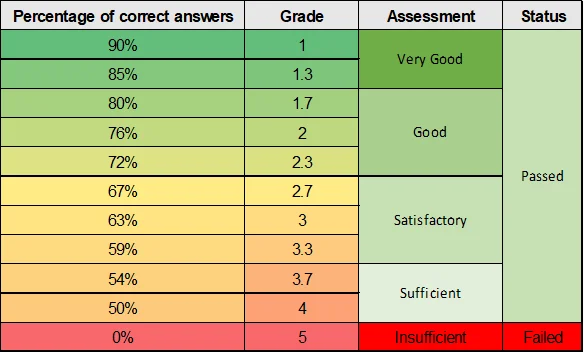
The following Grading Table sets out the grading scheme used in the MBA program:
[1] AllgStuPO – General Study and Examnition Regulatons of Technische Universität Berlin, 2020
[2] 2 times 6 ECTS
All study and examination procedures of the Energy Management MBA are governed by the General Study and Examination Regulations (Allgemeine Studien- und Prüfungsordnung – AllgStuPO) of Technische Universität Berlin, available here:
General Study and Examination Regulations (AllgStuPO) – TU Berlin
The General Study and Examination Regulations contain the overarching rules and procedures that apply to all degree programs at TU Berlin. These cover topics such as enrollment, re-registration, part-time studies, leave of absence, termination of studies, and examination procedures.
In addition, each program is governed by its own study and examination regulations (Studien- und Prüfungsordnung – StuPO), which define the specific structure, curriculum, assessment methods, and requirements for the master’s thesis.
EM-specific Study and Examination Regulations (StuPO) – TU Berlin
There are also supplementary application and admission regulations (Zulassungs- und Zugangsordnung – ZZO) for master’s programs, which describe the requirements and procedures for admission to each program.
EM-specific Application and Admission Regulations (ZZO) – TU Berlin
The legal foundation for these regulations is provided by the Berlin Higher Education Act (Berliner Hochschulgesetz – BerlHG), which establishes the framework for all universities in Berlin. The BerlHG ensures the quality and comparability of study programs, guarantees academic freedom, and regulates key aspects such as admission, examinations, student rights, and degree recognition.
Together, these frameworks ensure that the Energy Management MBA meets the high academic standards of TU Berlin and the requirements of the State of Berlin, providing transparency, fairness, and quality in all aspects of study and examination.
Please note that the German versions of all official regulations are legally binding. English translations are provided for informational purposes only.
There is a high demand among businesses in the energy sector for broadly qualified specialists with integrative management and leadership skills and expert knowledge of specific sectors. Excellent career prospects are available to graduates, particularly in leading positions within the energy sector as well as in general middle and senior management positions. Typical employers include consultancies, energy providers, energy service providers and technology companies within the energy sector, commercial operations with high energy requirements, regulatory offices, consumer and environmental protection associations, specialized investment businesses as well as the mobility and transport sector.
In Europe, there is an increasing demand for experts who understand Energy Management. This program enables students to specialize in the most demandable field of energy management. After graduating from this MBA program, you will find yourself with plenty of career options! Graduates of the MBA in Energy Management. offered by the Technische Universität Berlin great job opportunities working in:
Download the Student Manual for more insights!
The application deadline is March 31st of each year for a start in October of the same year.
Our next intake is for the academic year 2026/2028 starting in October 2026. The application period (see required documents below) runs from Mid-January through March 2026.
The number of students is limited to 30 per year. An admission committee decides about the selection based on a ranking taking into account overall qualification, work experience, language skills, results of former studies, and the study profile.
If you have any questions regarding the application procedure for the Energy Management MBA, please contact Mrs. Sandra Lubahn at sandra.lubahn@campus.tu-berlin.de.
The tuition fee for the master’s program is 19,800 Euro (6,600 Euro per semester) plus the regular TU administration fees of currently 329.09 Euro per semester. The tuition fees cover all courses and materials and includes the semester ticket for the use of public transport in the Berlin city area (tariff zones ABC). Tuition fees and the in/exclusion of the semester public transportation ticket are subject to change. Please check the regular administration fees for the latest information.
Fees can be paid by Flywire.
Schneider Electric is offering scholarships for this program.